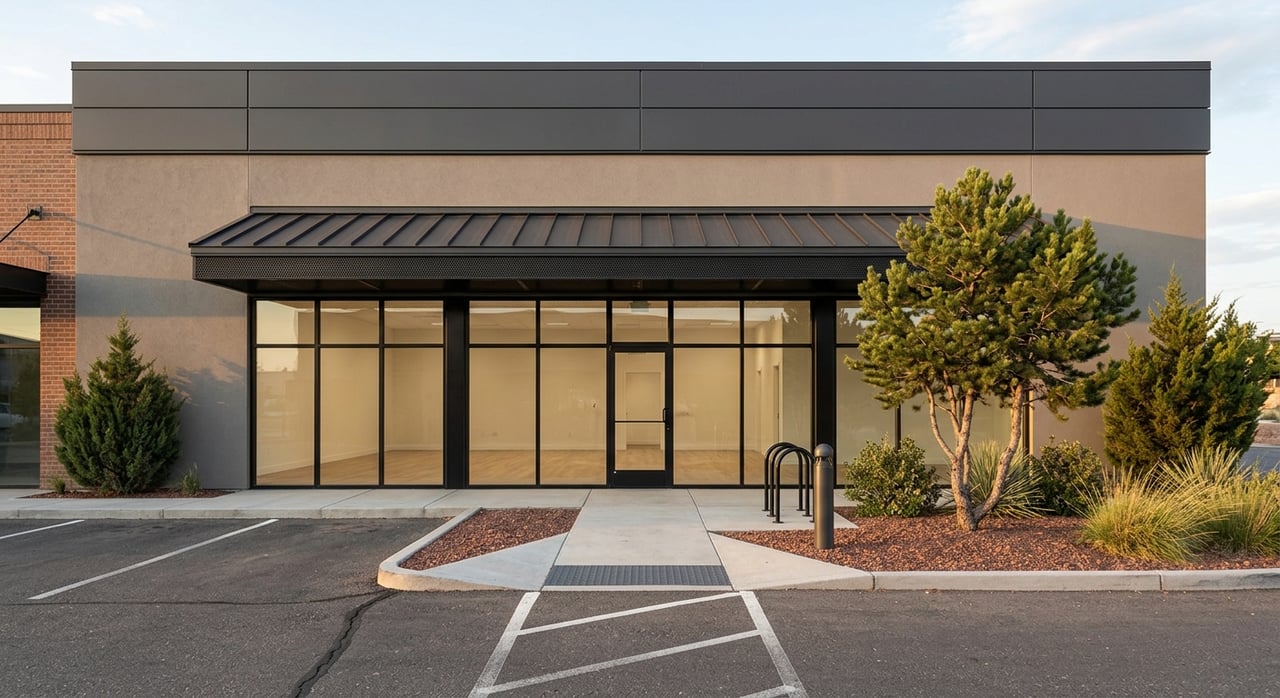
Rifle Retail Space Guide: Should You Lease or Buy?
July 2, 2026
July 2, 2026
Need more than a good address to make a retail space work in Rifle? You do. The right choice often comes down to how your customers reach you, what your total occupancy cost looks like, and whether the property fits your business before you sign or buy. If you are weighing a lease against a purchase in Rifle, this guide will help you compare your options with a local, practical lens. Let’s dive in.
In Rifle, retail space is not concentrated in one single shopping district. City planning materials point to community commercial activity along the Highway 13 and Railroad Avenue corridors, with regional commercial activity near the Airport Road roundabout area. Downtown Rifle is also a defined focus under the city’s downtown strategic plan and Central Business District code.
That means your search should begin by separating downtown storefronts from highway and corridor retail. They can both work well, but they serve customer access in different ways. In simple terms, downtown tends to support walk-in visibility, while corridor sites often lean more on vehicle access and frontage.
Downtown space can offer strong street presence and a traditional storefront feel. It may be a good fit if your business benefits from customers arriving on foot, browsing nearby businesses, or seeing your storefront along the core downtown blocks.
But downtown also comes with operating details you need to study closely. Rifle enforces 2-hour parking limits in designated downtown blocks, including parts of 3rd Street, 4th Street, 5th Street, Railroad Avenue, East Avenue, West Avenue, and East 5th Street. For some businesses, that may be manageable. For others, it can directly affect customer convenience and staff parking.
The city’s Central Business District code also treats parking differently than a typical shopping center. Required off-street parking for nonresidential uses may be located anywhere in the CBD, and applicants may need a parking report explaining how parking needs will be met through on-street, shared, public, structured parking, or fees-in-lieu.
Highway-adjacent and Airport Road retail solves access in a different way. Public listing examples near Rifle include Rifle Commons at 1000 Airport Road, which shows 1,375 to 1,430 square feet at $18 per square foot per year NNN, 178 parking spaces, and 300 feet of frontage. Another example is Shoppes at Rifle at Airport Road and Megan Avenue, marketed at $24 per square foot per year NNN with spaces from 1,600 to 18,400 square feet and an end-cap drive-thru option.
These examples suggest why many corridor sites appeal to businesses that depend on easy car access, visible frontage, and simpler parking. If your customers are driving in from I-70, stopping for quick visits, or relying on direct access from major roads, this location type may offer a more natural fit.
Commercial leases are more customized than residential leases. There is usually no standard form, and major business points are negotiable. Before you compare asking rents, make sure you understand exactly what is included and what is not.
Some of the most important lease terms include:
A quoted rate of $18 or $24 per square foot per year does not tell the whole story on its own. If the lease is NNN, you also need to add the pass-through costs, which commonly include common area maintenance, building insurance, trash, and property taxes.
A simple first check is:
annual rent = quoted $/SF/YR × rentable SF
Then add NNN or other pass-through costs if the lease is not gross. After that, divide by 12 to estimate the monthly occupancy cost.
For example, if a 1,400-square-foot suite is quoted at $18 per square foot per year, the base annual rent would be $25,200. That equals $2,100 per month before NNN charges. If the property also passes through taxes, insurance, and common area costs, your real monthly number will be higher.
Buildout can change the economics fast. A space that looks cheaper on paper may cost more overall if you need heavy improvements, utility changes, or a new layout.
Longer lease terms can sometimes help if you need substantial work done. Commercial leasing guidance notes that landlords are often more willing to contribute to improvements when the lease term is longer. That does not guarantee a concession, but it is an important negotiation point to raise early.
Buying can make sense when the property fits both your operating needs and your long-term real estate goals. It usually requires more cash up front, but it may offer more control over the property and how you use it over time.
In Rifle, recent downtown retail sale examples show small storefront asking prices in roughly the $255 to $275 per square foot range. Public listing examples include 119 W 3rd Street at $699,000, or $275.41 per square foot, and 127-129 E Third Street at $1.2 million, or $254.61 per square foot.
That gives you a starting point for comparison, not a final answer. If you are deciding between leasing and buying, compare those asking prices against financing costs, expected holding period, building condition, taxes, and the flexibility your business needs.
It is easy to assume ownership is always better because you control the property. In practice, the better choice depends on your cash position, growth plans, and whether the building is a good real estate investment for your business.
Leasing can preserve flexibility and reduce the amount of capital tied up in real estate. Buying may make more sense if the location is a strong long-term fit and the property supports your business as well as your balance sheet.
In Rifle, local approvals and property details should be part of your review before you commit. This is true whether you plan to lease or buy.
Start with the city’s approval path. If your business requires a sales tax license, the City of Rifle says the owner should complete the Sales Tax Zoning Review Sheet. The city also requires a commercial sign permit, and sprinkler systems require a permit and annual backflow testing.
If your project touches sidewalks, streets, alleys, or other city property, the city requires a right-of-way permit. These are not small details. They can affect your timeline, your opening costs, and whether a space is truly ready for your intended use.
Rifle’s interactive GIS map is a useful early screening tool. The city says it includes information such as addressing, ownership, floodplain, utilities, and zoning.
That can help you narrow options faster and ask better questions sooner. The city also notes that GIS maps are thematic tools and should not replace surveys or legal documents, so use them as a starting point rather than a final verification source.
If you are buying, review county records early in the process. Rio Blanco County says the assessor identifies, classifies, and values property in the county, sends valuation notices, and accepts protests during the annual cycle.
That makes the assessor’s office a key source for property tax history and valuation context. Before making an offer, confirm the record, assessed value, and tax history so you can underwrite the property more accurately.
Before leasing or buying retail space in Rifle, focus on the questions that most directly affect day-to-day operations and total cost.
Do not compare properties on asking price alone. A lower rent can still be more expensive if the suite has less usable space, weak parking, limited signage, or major buildout needs.
Likewise, a downtown storefront and a highway retail bay may serve completely different business models even if their square footage looks similar. The best comparison is the one tied to how your customers arrive, how long they stay, and what it will cost you to occupy the space each month.
If your business needs flexibility, lower upfront commitment, or room to test a location, leasing may be the better path. If you have a longer time horizon, want more control, and find a property that also works as a sound real estate purchase, buying may be worth the deeper analysis.
In Rifle, that decision should be grounded in local realities. Parking rules downtown, car access along corridor sites, lease structure, buildout needs, city approvals, and county valuation records all matter. The right move is the one that fits your operations and your numbers, not just the headline price.
If you are comparing retail options in Rifle and want a valuation-driven view of the numbers, local due diligence can save time and reduce surprises. Connect with the S.U.R.E Team for practical guidance on commercial leasing, acquisition strategy, and property valuation across Western Colorado.
Stay up to date on the latest real estate trends.
Whether you are looking for business acquisitions, commercial investment or your dream home in Mesa County or surrounding areas, we’re here to help you move forward with clarity and confidence.