Site Selection Checklist For Industrial Users In Rifle
May 7, 2026
May 7, 2026
Need an industrial site in Rifle that actually works for your operation, not just your map pin? That is where many buyers get tripped up. A parcel can look right on paper, but if truck access, zoning, utility setup, or outdoor storage rules do not match your day-to-day needs, the deal can get expensive fast. This checklist will help you focus on the issues that matter most in Rifle so you can evaluate sites with more confidence. Let’s dive in.
Rifle is best understood as an access-driven industrial market. If your business depends on trucks, trailers, service vehicles, or regional distribution, route planning is not a side issue. It is one of the first filters you should apply.
CDOT identifies West Rifle Exit 87 and the I-70 connection to northbound CO 13 at Exit 90 as key access points. CDOT has also noted project conditions near Rifle that included lane closures, 12-foot width restrictions, and wide-load detours onto US 6. That makes route reliability, clearance planning, and alternate access part of practical due diligence.
Rifle also has Access Control Plans for SH 6L and SH 13/13A. For you, that means early verification of driveway spacing, curb cuts, and turning movements can save time later. A site that looks usable from the road may still have circulation or access constraints that affect operations.
Before you spend too much time on pricing, confirm how your vehicles will actually move to and through the property. This is especially important for contractor yards, light manufacturing, warehousing, distribution, and service businesses that rely on regular truck traffic.
Look at how the parcel connects to Exit 87, Exit 90, I-70, CO 13, and local truck routes. If your operation needs dependable east-west movement or a practical northbound connection, these links matter to scheduling, fuel costs, and driver efficiency.
CDOT has also identified a northern alternate route via Rifle Exit 87 and CO 13, returning to I-70 at Exit 90. That may help some users with regional movement planning. Still, you should confirm whether that routing works for your equipment, trailer type, and timing.
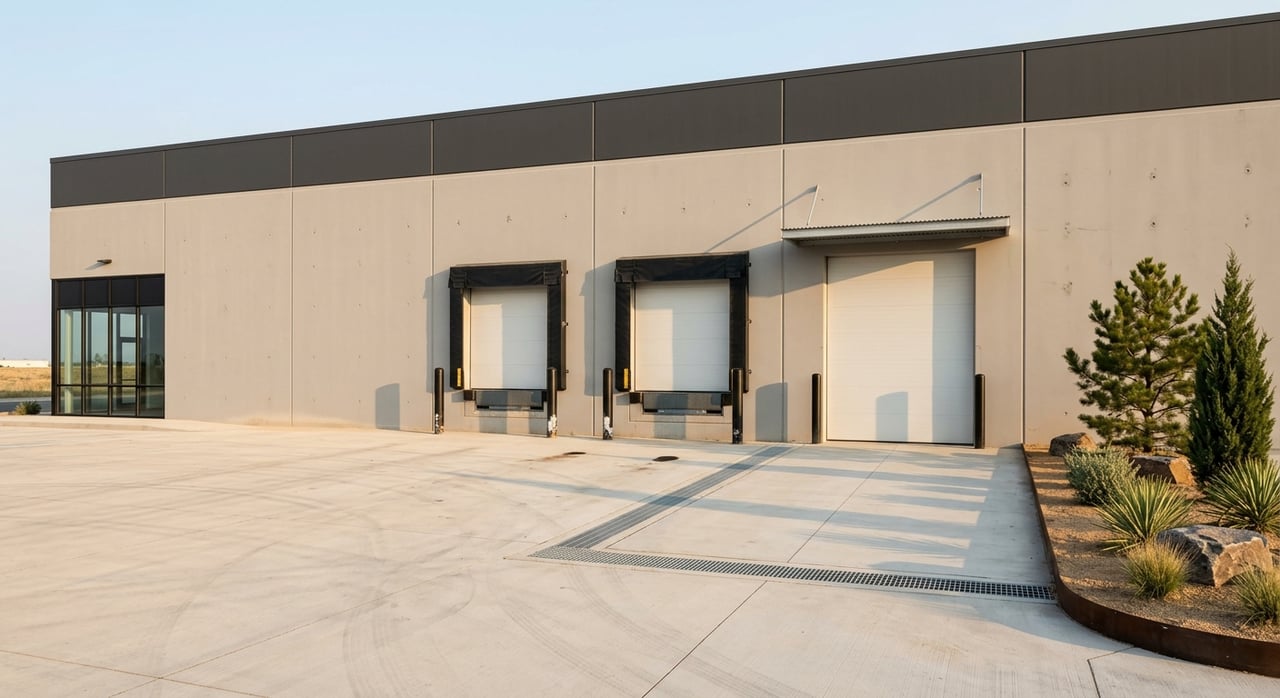
A site may have enough acreage and still fail operationally. You need room for trailer queuing, turning radii, loading activity, employee parking, and snow storage on the busiest day of the year, not just a normal day.
This matters even more in planned developments. Rifle Business Park PUD guidelines emphasize landscaping, screening, building design, and coordinated storm drainage, which signals that site appearance and site function are both part of local review.
If the parcel fronts or connects to controlled corridors, ask early about driveway approvals and truck movements. Access control is not just a road issue. It can shape how efficiently your site works for deliveries, yard use, and customer or vendor traffic.
One of the biggest mistakes industrial buyers make in Rifle is assuming all industrial zoning means the same thing. It does not. Rifle uses multiple industrial-related districts and planned developments, and each one can affect what you can do on the property.
Rifle's LI district is intended for less intense, visually unobtrusive, clean and quiet commercial and light industrial uses. In that district, manufacturing, assembly, and fabrication must occur inside a building or enclosed area.
The I district is broader. It can accommodate storage yards and processes both inside and outside buildings. If your business depends on outdoor equipment, materials, fleet parking, or visible operational activity, that distinction is a major site-selection issue.
If the site is in a PUD such as Rifle Airpark or Rifle Business Park, expect more than base zoning. These areas may include additional standards for building design, loading, parking flexibility, height, lot coverage, open-space buffers, and phased infrastructure.
That is not necessarily a negative. For some buyers, stronger design and infrastructure standards can support long-term value and a more coordinated business environment. But you need to know those rules before you underwrite the deal.
If you plan to store trailers, equipment, pipes, materials, or service vehicles outside, do not assume it is allowed just because the site is labeled industrial. In one recent Rifle review, a contractor's yard in Light Industrial zoning was treated as a conditional use because of the scale of outdoor storage and equipment.
That tells you something important. Outdoor use, screening, fencing, and visibility may trigger extra review depending on the district, the scale of the operation, and the specific development standards.
Your first use case matters, but your second and third use cases matter too. A building that works for your current footprint may still be a poor choice if it limits expansion, outdoor operations, or a future change in workflow.
Rifle's planning materials distinguish between light-industry uses such as indoor fabrication, contractor shops, design centers, R&D offices, and energy-support services, and broader industrial uses such as manufacturing, warehousing, distribution, production facilities, and indoor or outdoor storage. That means you should evaluate not only what fits today, but also whether your likely growth path still fits the district.
Do not rely only on total lot size. Focus on usable yard area after setbacks, landscaping, drainage features, parking, loading zones, and buffers are accounted for.
This is especially important in PUD settings or airport-adjacent locations, where additional controls may apply. If your operation depends on outside circulation and storage, usable area matters more than gross acreage.
Ask yourself a few practical questions before you move forward:
A site that barely works on day one often becomes expensive by year two.
Utility service can be a real advantage in Rifle, but you still need to verify the details parcel by parcel. Do not assume service availability, provider responsibility, or cost structure without checking.
Rifle reports substantial utility infrastructure, including 73 miles of water main, a water treatment plant with 6 million gallons per day of firm pumping capacity, 8.2 million gallons of storage, 53 miles of sewer, and a wastewater plant rated at 2 million gallons per day. The city provides drinking water and wastewater treatment to Rifle and the surrounding area.
That is a meaningful asset for infrastructure-intensive users. Even so, you should still confirm service location, capacity, extension needs, and any off-site improvement requirements for the specific parcel.
A property just outside the city boundary may look similar to one inside the boundary, but operating costs may differ. Rifle's 2026 utility rates show out-of-city water and sewer billed at 150% of the in-city rate.
That can affect your long-term occupancy cost and project underwriting. Before making an offer, verify whether the parcel is inside city limits, outside city limits, or may require annexation.
Electricity is not a city utility in Rifle. The city's utility information lists Xcel Energy and Holy Cross Energy for gas and electricity service.
For industrial users, provider coordination should happen early. Service type, capacity, extension timing, and infrastructure responsibilities can all influence your budget and opening timeline.
In Rifle, entitlement risk should be part of site selection, not an afterthought. The city publishes separate application packets and checklists for rezoning, annexation, CUPs, PUD approval, and site plan review. That is a strong signal that process matters.
Before you get under contract, verify whether the site needs any of the following:
Even if the existing use looks close to your needs, a missing approval can delay occupancy, add cost, or change the scope of what you can do on the property.
A site with a low purchase price is not always the better deal. If it carries zoning uncertainty, outdoor storage restrictions, or utility-extension needs, the total project timeline may become the bigger issue.
For owner-occupiers and operating businesses, delays have real costs. Rent overlap, postponed equipment install, staffing delays, and lost production time can all affect the bottom line.
Rifle's planning documents point industrial growth toward Airport Road and the Airpark. The area south of Airport Road was planned for Airport-Light Industrial and Airport-Industrial districts, while the north side was expected to include business and commercial districts.
The corridor has been described in planning materials as a light-industrial area with heavy truck traffic and energy-service users. For some businesses, that creates a strong operational fit. It may also support clustering near complementary commercial and service activity.
Airport-area sites deserve extra scrutiny. Rifle Business Park PUD materials note avigation easements because of proximity to the Garfield County Airport, and Airpark documents reference controls related to height, parking and loading, and phased infrastructure.
If you are considering a site near the airport, confirm those factors early. They may affect building design, long-term expansion, and even how you use outdoor areas.
Rifle's community materials identify nearby resources that include Colorado Mountain College, the Rifle-Garfield County Airport, fire and EMS, and other business-development resources. That mix can support contractor, logistics, and service users.
At the same time, you should evaluate traffic, visual compatibility, and operating patterns carefully. Industrial land in Rifle is not interchangeable with generic commercial land, and surrounding uses can shape both entitlement and functionality.
If you are comparing multiple properties, use this short checklist to keep your review disciplined:
In Rifle, the best industrial site is rarely the one that only looks good on a flyer. It is the one that lines up with your access needs, zoning profile, utility setup, site layout, and growth plan without creating avoidable entitlement risk.
If you are evaluating industrial property in Rifle or elsewhere in Western Colorado, a disciplined, valuation-driven review can help you avoid expensive surprises and compare options more clearly. If you want practical guidance on industrial acquisitions, owner-occupier property strategy, or property valuation, connect with GSD Broker Team.
Stay up to date on the latest real estate trends.
Whether you are looking for business acquisitions, commercial investment or your dream home in Mesa County or surrounding areas, we’re here to help you move forward with clarity and confidence.