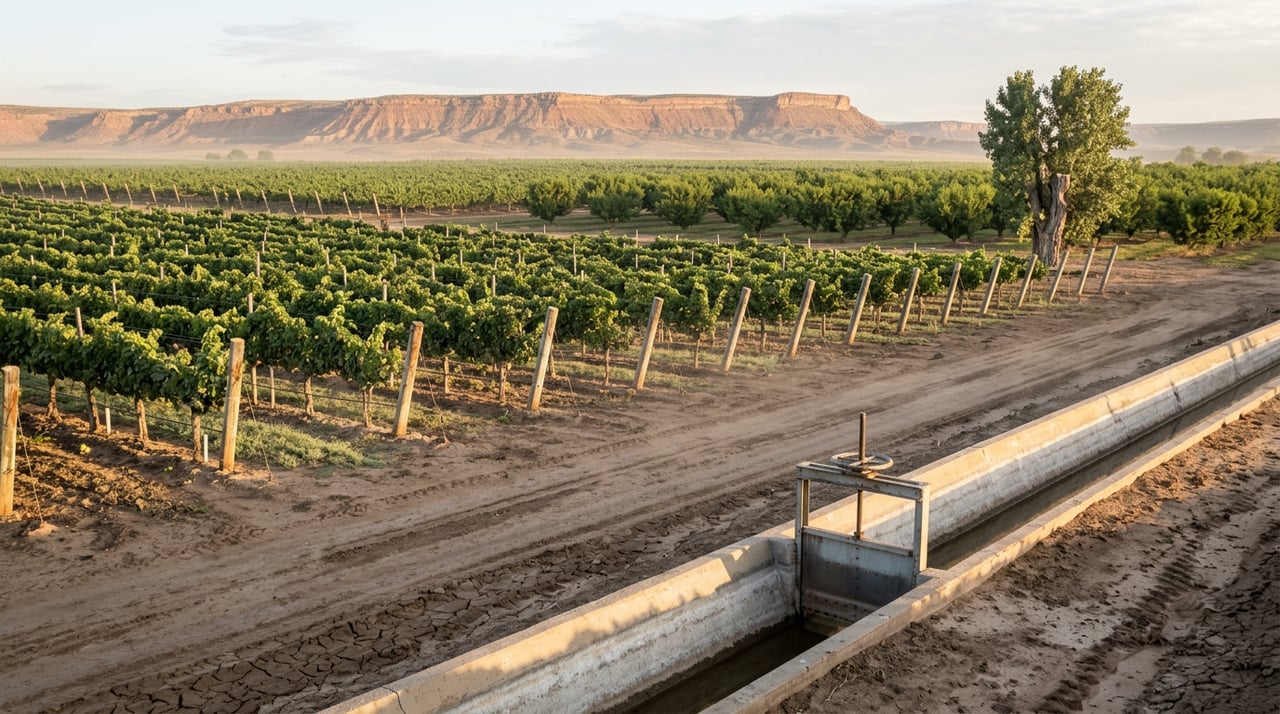
In Palisade, the Acre Isn't the Number That Matters. The Water Right Is.
September 24, 2026
September 24, 2026
On September 3, 2026, the Grand Valley Water Users Association told the growers it serves to close their turnouts and wait. The Government Highline Canal had fallen too low to keep delivering water, a shortfall the Association had already flagged a week earlier when it warned that reservoir storage was running out. The shutdown landed exactly when predicted. Users were instructed to protect their pumps and stand by for word on whether monsoon moisture would bring the canal back online.
A few miles away, on the same river, in the same drought, growers holding water through the Grand Valley Irrigation Company kept irrigating. GVIC entered the 2026 season expecting to deliver roughly 80 percent of a normal year's water despite conditions that Palisade Irrigation District superintendent Dan Crabtree described in blunt terms. "My key word has been dire. Bleak. It's record-setting," Crabtree told the Colorado Sun in early August, after visiting a Colorado River so low near Glenwood Springs that exposed rock beds where he'd normally never consider wading. Near Palisade that same week, the river briefly dropped to 42.9 cubic feet per second, a flow more typical of a mountain creek than the artery that irrigates an entire valley, before partially recovering by afternoon.
Same valley. Same drought. Two very different summers, decided almost entirely by a distinction that never shows up in a listing's headline number: which of five separate irrigation entities actually serves that parcel, and whether the water attached to it is a right that stays with the land or a share of stock that has to be assigned by certificate.
That distinction, not acreage, is the variable a Palisade land buyer should be pricing first.
Palisade sits inside a patchwork of irrigation providers that predate most of the town's zoning code. Grand Valley Irrigation Company holds the senior position on the river, entitled to the first 520 cubic feet per second before anyone else gets a drop. Palisade Irrigation District and Mesa County Irrigation District follow with a combined right of 120 cfs. Orchard Mesa Irrigation District carries a 460 cfs right, though its water moves through a hydroelectric pumping arrangement that makes its delivery timing more complicated than a straight canal draw. The Grand Valley Water Users Association, which operates the Government Highline Canal, holds the largest paper right at 730 cfs, but it is junior to all four of the others, which is exactly why it was the entity forced to pause deliveries first this September.
Priority order isn't a technicality. In a year when the Colorado River basin saw its 29th-lowest precipitation total in 130 years of record-keeping, according to Colorado River District water resources director Raquel Flinker, priority is the difference between a normal season and an interrupted one.
| Provider | Approximate right | Priority | Water conveyance |
|---|---|---|---|
| Grand Valley Irrigation Company | 520 cfs | Senior | Stock shares, not tied to land, bought and sold by certificate |
| Palisade Irrigation District | Shares 120 cfs with MCID | Mid-senior | Stays with the land through formal district transfer |
| Mesa County Irrigation District | Shares 120 cfs with PID | Mid-senior | Stays with the land, assessed by County Treasurer |
| Orchard Mesa Irrigation District | 460 cfs | Mid-senior, complex hydro arrangement | Stays with land unless formally transferred through OMID |
| Grand Valley Water Users Association | 730 cfs | Junior, last in line | Stays with the land, billed directly to the property owner |
A listing that says a parcel "has water rights" is doing less work than it sounds like. Under Palisade Irrigation District, Mesa County Irrigation District, Orchard Mesa Irrigation District, and the Water Users Association, irrigation water is appurtenant to the land, meaning it generally transfers with the deed as long as the transfer paperwork is filed correctly with the district.
Grand Valley Irrigation Company works differently. GVIC water is company stock, evidenced by a physical certificate, and it is explicitly not attached to any parcel. The company holds 48,000 shares among roughly 3,000 shareholders, with each share worth about 4.6 gallons per minute of direct flow. For the 2026 season, GVIC assessed its first share on every account, called an A share, at $376.90, with additional B shares billed at $18.03 each. Selling shares requires the current assessment paid in full, the physical certificate in hand, and a $30 transfer fee per new certificate. None of that happens automatically at closing. A buyer who assumes GVIC water comes with the dirt because a neighbor's district water does can end up owning a parcel and negotiating separately, after the fact, for the water that makes it useful.
The stock structure also means GVIC shares carry their own market value, separate from land. A past classified listing in the Grand Junction Daily Sentinel offered Grand Valley Irrigation shares at $5,000 apiece, cash only. Whatever the current trading price, the point holds: on a GVIC parcel, the water and the ground are two different assets that happen to sit in the same place, and a purchase agreement needs to name both.
This is the piece that explains a spread in Palisade land pricing that otherwise looks arbitrary. Active vineyard listings around Palisade have recently averaged roughly $188,000 per acre, with the handful on the market averaging about $1.5 million total. Palisade land overall, mixing bare ground with in-town parcels, has averaged closer to $170,000 per acre across roughly 75 active listings. Meanwhile, raw agricultural and orchard-zoned ground can trade for a fraction of that. One recent Palisade listing with panoramic Grand Mesa and Book Cliffs views was priced near $43,000 an acre. A 12.83-acre peach orchard inside Palisade town limits, complete with a 5,200-square-foot packing shed built in 2008 and served by Town of Palisade water and sewer, sits in a similar range, zoned Agricultural, Forestry, Transitional.
The gap between $43,000 and $188,000 an acre isn't mostly about vines versus bare dirt. A working vineyard typically comes with its water arrangement already solved: shares turned out to a specific headgate, assessments current, delivery history established across multiple seasons. Raw ground often carries an unresolved water question, or a junior right that just spent September without a canal. Buyers are not really paying a premium per acre for grapes. They are paying for the water question having already been answered and documented.
That distinction matters just as much for anyone evaluating an orchard or vineyard as an income-producing business rather than a lifestyle purchase. A Broker Opinion of Value on a working agricultural operation has to treat water security as a direct input to revenue, not a footnote, because a junior right in a drought year changes what that operation can actually produce and sell.
Palisade was named the best small town in the West in USA Today's 2026 Readers Choice Awards, a recognition that is likely to pull more buyers toward its orchard and vineyard acreage over the next few seasons. That makes the due diligence questions below more urgent, not less, because rising demand tends to compress the time buyers spend verifying details before writing an offer.
Before an offer goes in on any Palisade acreage, a buyer or their advisor should be able to answer:
Does every property in Palisade come with irrigation water? No. Domestic water and irrigation water are separate systems in the Grand Valley, and plenty of parcels carry only domestic service. Confirming irrigation status with the applicable district should happen before assuming a vineyard, orchard, or even a green lawn is achievable, and before a contract is written.
Will this drought permanently change who has priority? No. Priority dates are fixed under Colorado's prior appropriation system and don't shift because of one dry year. What does shift is delivered volume in a given season, and 2026 is a clear example: even Grand Valley Irrigation Company, holding the senior right, planned for an 80 percent year rather than a full one.
Who do I call to confirm which entity serves a specific parcel? Grand Valley Irrigation Company, Palisade Irrigation District, Orchard Mesa Irrigation District, Mesa County Irrigation District, and the Grand Valley Water Users Association each maintain their own service area records and can confirm status directly. Getting that confirmation in writing before closing is worth the extra week it takes.
Water rights are the kind of detail that separates a clean agricultural acquisition from a costly surprise, and they're exactly the sort of thing a proper valuation accounts for before a number ever gets attached to an offer. If you're evaluating land, a vineyard, or an orchard operation anywhere in the Grand Valley, the team at GSD Broker Team can walk through the water question alongside everything else that determines what a property is actually worth. Get a Free Business & Property Valuation to start with the facts on your specific parcel.
This article is general information, not legal, tax or financial advice. Consult a qualified professional about your situation.
Stay up to date on the latest real estate trends.
Whether you are looking for business acquisitions, commercial investment or your dream home in Mesa County or surrounding areas, we’re here to help you move forward with clarity and confidence.