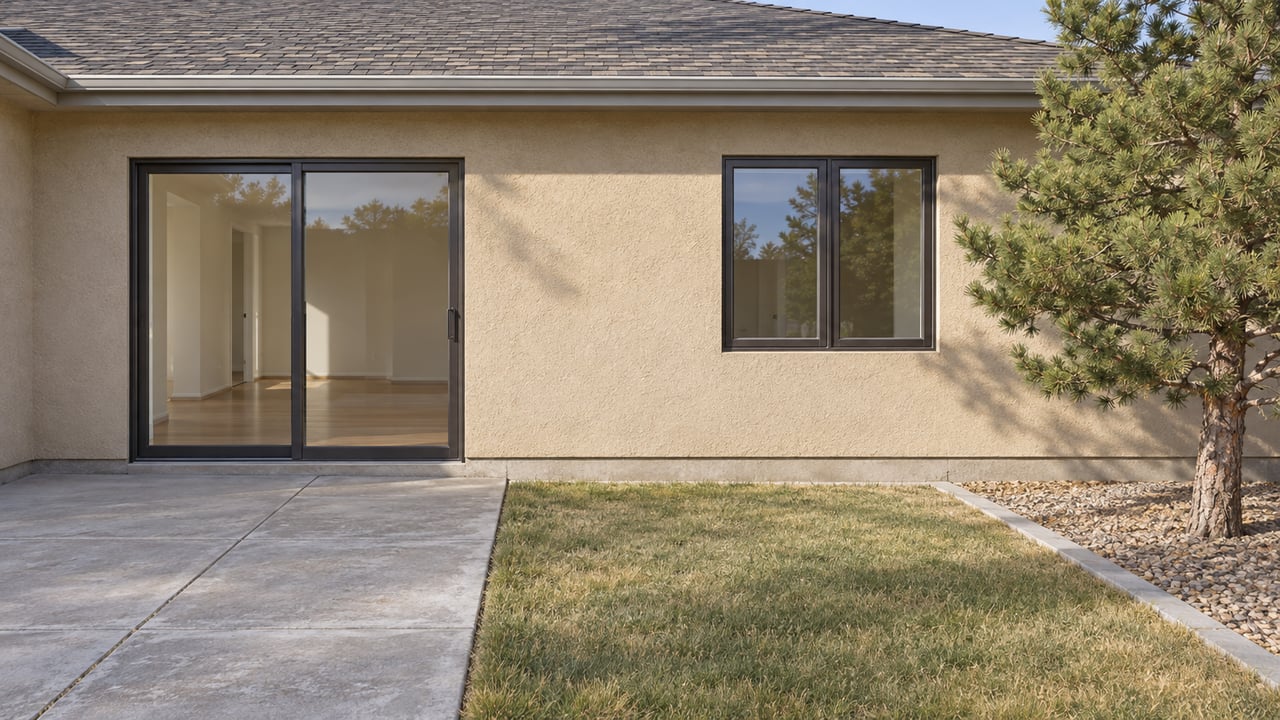
Fruita Will Help Pay for Your Backyard ADU. The Water Tap Is Where the Math Gets Real.
October 15, 2026
Every accessory dwelling unit built in Fruita needs its own water tap and meter. That rule comes from Ute Water, not the city, and in 2026 the smallest residential tap on Ute's schedule costs $8,750. In December 2025 the City of Fruita announced a grant-funded program that would give eligible homeowners about $5,000 in waived or reduced fees for a new ADU.
So the incentive covers a bit more than half of one required connection charge. If you're comparing Fruita homes partly because a lot has room for a second unit, that gap tells you more about what the lot is worth than the zoning map does. Fruita's zoning has allowed ADUs on most single-family lots since 2020. What drives the economics is the set of hookup charges that come with each unit, which are set by tap size rather than square footage.
Ute Water Conservancy District serves Fruita, and its Rules and Regulations, adopted January 2026, spell out the requirement plainly:
"As a single family residential service, each single family residence and each accessory dwelling unit on a parcel of land shall have a separate tap and meter."
You can read that language in Ute Water's adopted rules. The same document says tap variances stopped being available on January 2, 2021, so you can't ask for an exception to share the main house's tap. Ute does allow master meters for qualifying multifamily buildings. A single-family lot with an ADU is handled under the single-family rule, which requires the second tap.
Ute Water's 2026 tap fee table lists $8,750 for a 5/8-inch tap and $10,800 for a 3/4-inch tap. The rates page doesn't carry a publication date, so confirm the current figure with the district before you put it into a budget.
The table below lists the per-unit charges that appear in Fruita's 2026 Fees and Charges schedule and Ute Water's tap table. Some apply to every ADU. One is still unresolved.
| Charge | 2026 amount | Applies to a new ADU? |
|---|---|---|
| Ute Water tap, 5/8-inch | $8,750 | Yes, per Ute's separate-tap rule |
| Ute Water tap, 3/4-inch | $10,800 | If that size is required |
| Fruita sewer Plant Investment Fee, inside city limits | $7,000 | Not stated in city ADU materials |
| Fruita sewer Plant Investment Fee, outside city limits | $14,000 | Not stated in city ADU materials |
| Planning Clearance, detached single-family unit | $25 | Yes |
| Use tax | 3% of valuation | Yes |
| Building permit | Scaled to valuation | Yes |
Two of these lines scale with the project. Use tax runs 3% of construction valuation, so each $100,000 of valuation adds $3,000. The building permit fee also rises with valuation. The water tap is priced by tap size, not by square footage. If a 500-square-foot studio and a 1,000-square-foot two-bedroom both get a 5/8-inch tap, each pays $8,750 to connect.
The sewer line is the real open question. Fruita's August 28, 2026 City Manager update lists Ute Water tap fees among the costs the ADU program can help with, alongside building permit fees, use tax and planning clearance fees. It doesn't mention the city's sewer Plant Investment Fee, and the city materials we reviewed don't say whether an ADU owes its own. If an ADU inside city limits owes the full PIF, the two utility charges come to $15,750 before any permit, tax or construction cost. If it doesn't, the water tap alone still costs more than the announced assistance.
Fruita expanded where ADUs are allowed when it updated its zoning code in 2020. The city's own count is 25 ADU permits issued from 2020 through 2025. The zoning allowance is broad. Under the current Land Use Code, ADUs are permitted on any lot with a detached single-family home in the Rural Estate, Large Lot Residential, Community Residential, South Fruita Residential, Monument Preservation, Downtown Mixed Use and Commercial-1 zones, plus the Neighborhood Commercial Overlay. The Colorado Department of Local Affairs also lists Fruita as an ADU Supportive Jurisdiction under HB24-1152, the 2024 state law that requires covered jurisdictions to allow ADUs wherever detached single-family homes are allowed and to approve them administratively without a public hearing.
The city's grant money goes to costs that come before construction. DOLA's ADU Grant Program page shows a $75,000 first-round award to Fruita for fee waivers and a second $75,000 award, made in May 2026, for pre-approved plans. Fees and design are both costs a homeowner pays before building anything. Fruita's recommended 2027 budget carries the work forward with $100,000 from state grants for the two ADU programs, which it describes as helping "offset fees for an ADU, and for sample spec plans."
At about $5,000 per homeowner, the first $75,000 award covers roughly 15 projects. That would be a real jump over 25 permits in six years, and it still leaves each owner paying the rest of the tap.
The rule that sets ADU size matters more when you're comparing two listings. Fruita caps an ADU at 1,000 square feet of heated floor area or 50% of the main house's size, whichever is greater. The Community Development Director can approve up to a 10% adjustment at Planning Clearance. Each lot can have one ADU, attached or detached, and an attached unit must be able to function separately from the main home.
Since the cap is "whichever is greater," any house under 2,000 square feet gets the same 1,000-square-foot allowance. Above 2,000 square feet, the allowance grows with the house. A 3,000-square-foot home can support a 1,500-square-foot ADU before any adjustment.
That interacts directly with the fixed fees. If both units would use the same tap size, a larger allowed unit spreads that $8,750 over more usable space. Two Fruita homes at a similar price, one at 1,800 square feet and one at 2,800, have different ADU ceilings, and the larger ceiling makes the fixed connection cost a smaller share of the project.
Location relative to city limits matters too. Fruita's fee schedule sets the sewer Plant Investment Fee at $7,000 inside city limits and $14,000 outside. Fruita is still annexing land. In August 2026 the council annexed about 35.79 acres at 1925 J Road and rezoned about 36.14 acres there to Community Residential, which is one of the zones that allows ADUs. Whether a property is inside or outside the city line is a basic due-diligence question for any parcel near the edge of town.
The assistance has a condition. Fruita's December 2025 announcement says homeowners who receive it agree to keep the ADU off the short-term rental market for at least five years. City Manager Shannon Vassen said in that release that the goal is "ensuring these units remain available for long-term renters."
That ties the subsidy to how the unit is used. Fruita's ADU zoning language doesn't include an owner-occupancy requirement, and HB24-1152 generally bars those requirements, with limited exceptions. Separately, the city's short-term rental ordinance requires a permit for each STR unit and allows permits only for the property owner. If you might want short-term rental flexibility in the next five years, you're choosing between that and about $5,000 of assistance. The city's own materials describe ADUs as a fit for family members, a long-term rental, or a smaller housing option.
The $5,000 figure and the five-year restriction come from the December 2025 announcement. The August 2026 update says the program is operating but doesn't restate either term. Treat both as announced terms until the city confirms them.
In August 2026, the median single-family sales price in Mesa County was $439,900, and the townhouse and condo median was $367,500, according to the Colorado Association of Realtors local market update current as of September 3, 2026. CAR's August 2026 statewide report put Mesa County at 1,195 active listings and about five months of supply. Closed sales were down 16.3% from a year earlier.
Those are countywide figures. We didn't find a Fruita-only series for late summer. They still describe a market with more inventory and fewer closings than a year ago, which gives buyers time to ask questions. For a property bought with an ADU in mind, the questions that matter are about utility service, the size allowance and the sewer fee, and the answers belong in the offer price.
As of this writing, the city's public materials leave several program details unresolved. These are the ones to confirm with the City of Fruita and Ute Water:
Does Fruita require the owner to live on the property to build an ADU? Fruita's ADU zoning language doesn't include an owner-occupancy requirement, and HB24-1152 generally bars them, with limited exceptions.
Can an ADU share the main house's water meter? No. Under Ute Water's January 2026 rules, each single-family residence and each ADU needs its own tap and meter.
Is the fee waiver the same as Fruita's affordable housing projects? No. The ADU grants are separate from projects such as The Oaks, where the city is paying to restrict all 62 units to residents at 100% of area median income, and Fruita Commons, which is planned for 90 workforce units.
If you're weighing a Fruita property for its ADU potential, GSD Broker Team can line up the house size, zoning, city-limit status and utility charges for each property you're considering, so the second unit is priced in before you make an offer. Get a Free Business & Property Valuation.
This article is general information, not legal, tax or financial advice. Consult a qualified professional about your situation.
Stay up to date on the latest real estate trends.
Whether you are looking for business acquisitions, commercial investment or your dream home in Mesa County or surrounding areas, we’re here to help you move forward with clarity and confidence.